Showing posts with label word for the day. Show all posts
Showing posts with label word for the day. Show all posts
Wednesday, April 13, 2016
Not what you think it means
I just discovered the (real) word "galactagogue," and am immensely disappointed to learn that it does not in fact refer to a galactic demagogue.


Thursday, March 7, 2013
Word for the Day -- Izzat
 "Izzat" is a Hindi term, taken ultimately from Arabic, meaning (variously) "honor" or "dignity," or in some cases "prestige."
As Kipling says, in William the Conquerer,
'Scott spoke forcefully to Faiz Ullah and the two policemen, and bade them capture goats where they could find them. This they most joyfully did, for it was a recreation, and many ownerless goats were driven in. Once fed, the poor brutes were willing enough to follow the carts, and a few days' good food- food such as human beings died for lack of- set them in milk again.
'But I am no goatherd,' said Faiz Ullah. 'It is against my izzat.'
'When we cross the Bias River again we will talk of izzat,' Scott replied. 'Till that day thou and the policemen shall be sweepers to the camp, if I give the order.'"
So there you go. And next time someone asks you, "What izzat?", you'll know!
Tuesday, February 26, 2013
Word for the Day-- God's Penny
 According to the Big Book, God's Penny is ": a penny or small sum paid as earnest money esp. on concluding a purchase or hiring a servant." It's like saying, "I promise I'll pay you, but in the meantime here's a little something from God to tide you over."
On the one hand, it's kind of nice, since you're getting a little extra. On the other, the more I think about it the odder it gets. "Hey, God, what, you can't spare more than a penny?" Or alternatively, "Um, why does God need a
Hmm. A little more research shows that it's not actually supposed to be money from God, but rather money given in the sight of God-- sort of equivalent to "As God is my witness, I will pay you the agreed upon money." Which is still odd, but I guess not quite as odd. Because you're still suggesting that the money has some sort of significance to God, which, what? I mean, that works if you still worship Mammon or something, but the Judeo-Christian God is sort of supposed to be beyond all that.
Mm. Black's Law Dictionary (or at least what appears to be a poorly edited OCR scan of it) suggests that the small sum was customarily then given to charity or as alms. Which does more or less finally make sense of the name, actually. I'm actually sort of disappointed. This was much more fun when it didn't make any sense at all. Alas.
Friday, October 12, 2012
Word for the Day - Dégagé
The word dégagé is possibly my new favorite word-- at the very least, it's my favorite word until I get distracted by something shiny, such as the new banking app that lets me deposit checks from my living room. I love the future. Where was I?
Oh, yes. Dégagé is defined by the Big Book of choice as
1 : free of mental engagement and constraint of manner : carefree and indifferent to decorum : EASYGOING <I adopted a dégagé pose on the arm of a Morris chair -- S.J.Perelman> <rather dégagé after the nervousness he had shown at dinner -- Edmund Wilson>
2 : marked by a free and easy show of unconcern for strict conventions <the famous slouch hat with the nonchalant dégagé air -- A.J.Liebling> <a model of crushed pink velvet dipped low over one eye and soaring in a dégagé movement on the opposite side -- Hats>
It's like being nonchalant, or easygoing, only with less implications of slack and more class. Because it's French. I like to think that it describes me, actually. But then, I suppose I would. Also, I would like a slouch hat, even if it isn't necessarily famous. I don't really need one made of pink velvet, though, no matter how Mad my Hatterdom. That's a little bit too dégagé.
Tuesday, October 2, 2012
Word for the Day -- ???
The tank in which sugar cane juice is clarified by treating it with a reagent (such as lime), heating it, and then separating out the scum and
sediment, is, or at least was in the late 1800's, called a defecator.Because deep down, I'm still 13 years old.
Ok, it's not really that deep down.
Friday, September 7, 2012
Word for the day -- Dead stock
I've heard of livestock. Everyone's heard of livestock. But did you know that there's also dead stock? Dead stock is, basically, all of the farm stuff (tools, equipment, etc.) that is not livestock. So a tractor is dead stock. Or a harvester. And an ax handle is dead stock woodstock, maybe.
Thursday, August 9, 2012
Word For the Day -- Dandy funk
Although this conjures images of a well-dressed gentleman in top hat and tails getting down with his bad self to the strains of Marcus Miller*, "dandy funk" is actually a foodstuff.
It is, according to the Authority, "hardtack soaked in water and baked with grease and molasses." The OED concurs, calling it "hard tack soaked in water and baked with fat and molasses." That's a very important distinction in there, you betcha (although they do indicate that they think it was more commonly a closed compound, "dandyfunk"). The Encyclopaedia Britannica offers up no opinion, which is probably just as well. It is alternatively described as "a mess made of powdered biscuits, molasses and slush," a staple(?) of sea-going fare, guaranteed to keep you alive, if not terribly happy.
Also, ew. Definitely need your grog ration if you want to choke that down.
*I have no actual funk favorite (or even particularly any knowledge), I just Googled "greatest funk" and picked a name at random out of the lists that came up.
Thursday, July 19, 2012
Word for the Day - Curse of Scotland
There are a lot of interesting language tidbits surrounding games, and poker has some of the best. There's the evocative language of the game itself-- terms for varieties of the game, like "stud," "High Chicago," or "Follow the Queen." There are nicknames for parts of particular games, such as Texas Hold 'em's "turn" and "river" (the fourth and fifth community cards). And most people have at least heard of "the Dead Man's Hand," (two pair, aces and eights), supposedly the hand that Wild Bill Hickock was holding when he was shot in 1876. But I think the absolute best one I have ever heard is "the Curse of Scotland," otherwise known as... the nine of diamonds.
It seems like an odd card to have such an inauspicious nickname, but there are several explanations floating around. The most lurid (and least convincing) involves a Scottish general writing the orders for an massacre on the back of a nine of diamonds (due apparently to lack of paper). A slightly more convincing explanation, although still without much actual supporting evidence, draws from the resemblance between the nine of diamonds and the coat of arms of Sir John Dalrymple, 1st Earl of Stair, who was known for being a ruthless and brutal commander. Either way, I can't wait until I find some way to work this into a friendly game of cards.

The Dalrymple/Stair crest.
It seems like an odd card to have such an inauspicious nickname, but there are several explanations floating around. The most lurid (and least convincing) involves a Scottish general writing the orders for an massacre on the back of a nine of diamonds (due apparently to lack of paper). A slightly more convincing explanation, although still without much actual supporting evidence, draws from the resemblance between the nine of diamonds and the coat of arms of Sir John Dalrymple, 1st Earl of Stair, who was known for being a ruthless and brutal commander. Either way, I can't wait until I find some way to work this into a friendly game of cards.
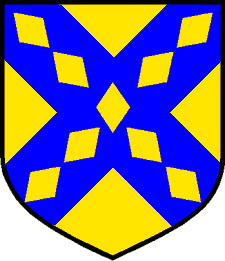
The Dalrymple/Stair crest.
Monday, July 9, 2012
Glonous History
For those of you out there who are partial to a common form of Americanized Chinese cuisine, and have been for at least a little while, you may be familiar with the archetypical example of what is sometimes (unflatteringly) called "Engrish," to wit: The Chopstick Instructions.
For those who can't read past the glare, it says, "Welcome to Chinese Restaurant. please try your Nice Chinese Food With Chopsticks the traditional and typical of Chinese glonous history. and cultual."
While I cannot speak to the typicalness of its glonous history, I did just find out that "cultual" is an actual word. It means "of or relating to cult or worship."
Given the excessive number of posts and images on the web about this particular chopstick exemplar, I have to admit the word may not be completely ill-chosen.
Thursday, April 26, 2012
Word for the Day-- Dvandva
"Dvandva" is a linguistic term. It refers to a type of compound term where both parts are of equal importance and are related to each other. The rule of thumb seems to be that if it could be split into two words separated by an "and" without changing the basic semantic content, then it qualifies.This is a relatively uncommon thing in English, where that sort of equality is hard to come by, but there are some examples-- the OED uses (in one of its quotes) the compound "prince-consort," which possibly says something about the OED, or maybe about the English language, I don't know. Webster's Third New Etc. uses the slightly more plausible "secretary-treasurer" and "bittersweet" as examples, although it also uses "sociopolitical," which strikes me as not being a very good example because "socio" is a prefix and doesn't stand on its own. Perhaps the equivalence in importance supersedes that; certainly, the term indicates an equivalence of social and political influence.
The term itself is derived from Sanskrit, where it means something like "pair," (literally "two and two.") Dva is related to a fairly large number of other words for "two" in other languages, such as "duo" (Latin), "dyo" (Greek), "dva" (Russian), etc. In the Sanskrit language, apparently, this sort of equivalence pair is much more common. It's also common in some Asian languages, according to Wikipedia.
Thursday, April 5, 2012
Word for the Day -- Compotator
Today's new word is "compotator," defined as "one who drinks with another." The derivation is fairly straightforward-- "com-", meaning "with" or "together" (as in "community," or "commingle"), and "potator," "one who potates." Ok, so that isn't all that straightforward, but it's the same root as "potable," which most people only encounter in the Jeopardy! category "potent potables." It means "drink."So a compotator is basically just a drinking buddy. This is another one of those words that no-one uses any more that I think really deserves a renaissance. "I'll see you later, dear-- I'm due to meet up with my compotators at the local pub." "I joined Gamma Delta Iota in my sophomore year so that I could live with my compotators."
Thursday, March 29, 2012
Word for the Day - comedo
"Comedo" is the technical name for a blackhead pimple. According to Webster's Third New International Dictionary, Unabridged, it is derived from New Latin, from a Latin word meaning "glutton," from comedere "to eat." I'm not entirely clear on what the connection is, but everything I can think of makes me vaguely ill from the associations.I didn't know this word, and thanks to that horrible, horrible etymology, I suspect I may never forget it. And now, perhaps, neither will you.
You're welcome.
Thursday, March 22, 2012
Word for the day -- College widow
A "college widow," according to the venerable Webster's Third New International Dictionary, Unabridged, is a "young woman in a college town who dates students of successive college classes."I cannot help but think that there must be some sort of story behind this. Apparently, it was the title of a stage production in 1904, and a subsequent silent film, but details of the story are lost, so it's hard to know if there is a connection. At least one reviewer claims that there is, for whatever that's worth, but seems to indicate that the term was part of the common lexicon at the time, indicating in turn that this was a relatively common occurrence. I'm a little bewildered, I must confess.
Thursday, March 8, 2012
Word for the day -- Redowa
 A redowa is a Czech dance, kind of like an energetic waltz, that was popular in Victorian ballrooms.
That was very short, so here's a little extra that I learned at the same time. In London, before 1924, printed works that were deemed worthy of legal protection were not marked as "copyrighted." Instead, they bear the label "Ent. Sta. Hall," which stands for "Entered at Stationer's Hall." The Stationer's Hall, as best as I can tell, is the official headquarters of what is now the Worshipful Company of Stationers and Newspaper Makers, originally founded in 1403 as the Stationer's Company, one of the original Livery Companies of the City of London. Protection of copyrights appears to be one of their main duties in the contemporary era.
Thursday, February 23, 2012
Word for the day -- Cockshut
Today's word is, as the heading says, "cockshut." This is a great word, because it sounds really filthy, but it's actually very straightforward-- cockshut is the time of day that poultry were traditionally shut away to rest, i.e. evening twilight. But I can just imagine a bunch of businessmen (or steelworkers, if that image is better for you. Whatever you like.) at the bar after work-- "Sorry, fellows, but I must be off. I prefer to be home for supper by cockshut." It's basically obscure British English dialect at this point, which is a shame. I think it deserves a renaissance.It should also not be confused with Cockshutt, a village/parish in Shropshire, or the Cockshutt Plow Company, founded in Ontario in 1877 by Ignatius Cockshutt.
Tuesday, February 14, 2012
Word for the Day -- Nycthemeron
Today's word is nycthemeron. Webster's Third New International Dictionary, Unabridged defines it as ": a full period of a night and a day." The OED concurs, entering it as "A period of twenty-four hours, consisting of a day and a night." I'm not sure why anyone needed a special word for this. Especially since the use of the simple "day" to mean a 24-hour cycle predates nycthemeron in English by at least four hundred years, more if you're willing to keep tracing it back through Old English. Wikipedia suggests that it was used specifically as a technical term to avoid ambiguity, which I suppose is plausible, but I don't find their backing terribly convincing, especially considering there isn't any.
All of this does, however, bring up an interesting point about language. Nycthemeron breaks down in Greek roots into nyct, meaning night, and hemera, meaning day. That's right, when the Greeks wanted to talk about a night-day cycle, they called it a "night-day." This reminded me of a recent XKCD comic, wherein Etymology Man notes that the similar-sounding word "entomology" comes from the Greek "entomon" (insect), from "entomos" (segmented). And I realized-- I'm so glad that I speak such a rich and nuanced language as English. In ancient Greek, they apparently saw little bugs crawling around, and decided to call them the equivalent of "crawlies." A lovely piece of art in two panels? A "two-fold"-- or diptych. Everything would be literal descriptions--not very creative. Frankly, it's hard to imagine how they managed to write anything at all poetic.
Wednesday, February 8, 2012
Word for the Day
Today's word is coaxation: a croaking especially of frogs, from Latin coaxatus (past participle of coaxare to croak, probably from
Greek koax noise made by a frog).It has nothing to do with broadband or cable wiring.
The OED features (as it always does) the earliest written reference to this word, from 1642: "D. Featley Καταβαπτισται Καταπτυστοι 227 (T.), I hope we shall see no more of their frog-galliards, nor hear of their harsh croaking and coaxation either in the pulpit or the press."
Wednesday, February 1, 2012
Word for the Day
The ornamental ponies that hypothetically adorn the sides of my socks would technically be referred to as “clocks,” as would be any other ornamental figures. These socks would therefore be (again, technically) referred to as "clock socks."http://www.merriam-webster.com/dictionary/clock?show=2&t=1328144183
Friday, January 6, 2012
Word for the Day
Today's word is "claire": a small enclosed pool for growing or observing the growth of oysters. "Bobby, go down to the claire and fetch us some Wellfleets for lunch!" "Yes, Maw."These pools are not named after anyone in particular. The name instead comes from the French clair, meaning clear. Presumably, these were relatively clear ponds, full of salt water but not muck.
Tuesday, October 25, 2011
Puts The Hobbit in a new light, really
I promise these won't all be about words-- that's just what I ended up with a couple of days in a row. Blame the job. Anyway.
It turns out that "Bilbo" acutally has a meaning, to wit:
: a long bar of iron with sliding shackles and a lock at the end that is used to confine the feet of prisoners especially on shipboard
To be completely fair, that's not the only meaning-- it's also used to refer to "a finely tempered sword." It is odd however to think of poor old Bilbo Baggins placed in irons in the hold of a ship after a poorly thought-out mutiny attempt. Both senses of "Bilbo" trace their etymology ultimately from Bilbao, Spain, historically an important source of iron ore and ironworks in Europe.
It turns out that "Bilbo" acutally has a meaning, to wit:
: a long bar of iron with sliding shackles and a lock at the end that is used to confine the feet of prisoners especially on shipboard
To be completely fair, that's not the only meaning-- it's also used to refer to "a finely tempered sword." It is odd however to think of poor old Bilbo Baggins placed in irons in the hold of a ship after a poorly thought-out mutiny attempt. Both senses of "Bilbo" trace their etymology ultimately from Bilbao, Spain, historically an important source of iron ore and ironworks in Europe.
Subscribe to:
Posts (Atom)